

Table of Contents
Building a custom home is one of the most rewarding projects a builder can take on.
It is also one of the easiest projects to derail if timelines, materials, and communication are not managed carefully.
Delays can quickly impact budgets, client satisfaction, subcontractor schedules, and profitability. Many builders enter a project with a solid custom home construction timeline, only to watch weeks or months disappear because of avoidable setbacks.
The positive news is that most delays are predictable.
When builders understand the biggest bottlenecks in the custom home building process, they can plan ahead, minimize downtime, and keep projects moving forward with fewer surprises.
At Northern Log Supply, we work closely with custom home builders across the country by supplying high-quality wood products including log siding, timber trusses, paneling, beams, railings, and more designed to streamline installation and improve project efficiency.
Why Custom Homes Experience More Delays Than Production Builds
Custom homes building projects naturally involve more moving parts than production homes.
Production builders repeat the same floor plans, materials, and workflows over and over. Custom builders are managing one-of-a-kind homes with unique layouts, specialized finishes, custom sourcing, and client-driven changes.
True custom home projects require more coordination because every decision can impact scheduling, labor, and material lead times. That is why understanding the most common delay points is critical.
Clients frequently ask questions like…
How long does it take to build a custom home?
How much does it cost to build a custom home?
Why do timelines keep changing?
Builders who can confidently answer these questions while reducing delays position themselves as trusted partners throughout the project.
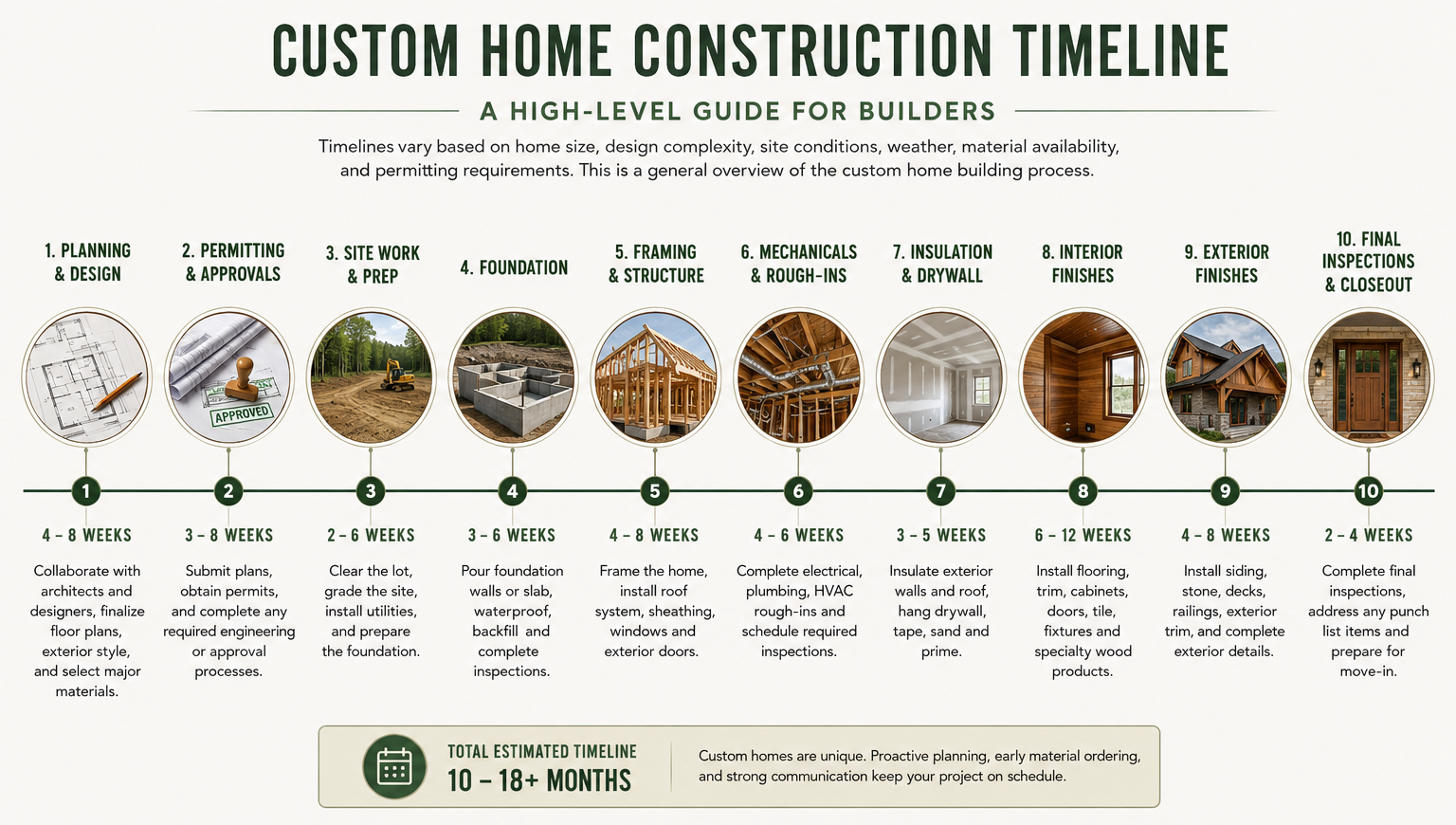
Before diving into the biggest causes of delays, here’s a high-level look at the typical custom home construction timeline builders work through during a project.
Understanding the Custom Home Construction Timeline
Every successful custom build starts with a realistic timeline.
One of the biggest mistakes builders and homeowners make is underestimating how many moving parts are involved in the custom home building process.
A typical custom home construction timeline includes planning and design, permitting, site preparation, foundation work, framing, rough-ins, insulation, interior finishes, exterior work, and final inspections. While many projects aim for a 10 to 18 month schedule, timelines can vary significantly depending on home size, customization level, weather conditions, labor availability, and material lead times.
The reality is that delays cannot always be eliminated completely.
However, most costly setbacks can be minimized with better planning and stronger coordination throughout the build.
Below are some of the most common delays builders face during custom home projects and practical ways to avoid them before they impact your timeline and profitability.
Delayed Material Deliveries
One of the biggest causes of delays in custom home construction is material availability.
Custom homes often require specialty products that are not sitting in a warehouse ready to ship.
Custom products and specialty finishes frequently involve manufacturing lead times, freight coordination, and scheduling windows. Even a single missing product can slow framing crews, interior finishing, or exterior installation.
Builders who wait too long to finalize selections often create bottlenecks later in the project. This is common with custom wood products, garage doors, windows, appliances, and specialty finishes.
Material backorders can add months to projects if products are not ordered early enough.
How to Avoid It
The best builders start material planning early in the design phase.
Instead of waiting until framing begins, successful new home builders coordinate suppliers well ahead of schedule to confirm:
- Manufacturing lead times
- Shipping schedules
- Product customization requirements
- Staining or finishing timelines
- Installation sequencing
At Northern Log Supply, our products are manufactured with installation efficiency in mind, including tongue and groove and end-matched systems that help reduce labor time on-site. Our team at Northern Log also offers pre-stained and pre-finished options that can help builders reduce mess, labor, and installation delays.
Working with suppliers that understand scheduling pressures can make a major difference in keeping projects on track.
Design Changes Mid-Project
Nearly every builder has experienced it.
Framing is complete and suddenly the homeowner wants larger windows. Cabinet layouts change after plumbing rough-ins. A staircase gets redesigned halfway through the build.
The more customized the home, the greater the chance of mid-project revisions.
Even small design changes can create a ripple effect across the entire build schedule.
Structural modifications, engineering updates, revised permits, reordered materials, and subcontractor rescheduling can quickly turn a manageable timeline into a frustrating one.
How to Avoid It
Builders should establish clear selection deadlines early in the custom home building process.
Clients often do not realize how much a “small change” impacts scheduling. Educating homeowners early helps reduce unrealistic expectations later.
Many experienced builders create milestone checkpoints for:
- Exterior finishes
- Window packages
- Interior wood selections
- Staircases and railings
- Trim and paneling
- Fixture selections
When these decisions are finalized before construction begins, the build moves much more efficiently.
This is important for custom wood products that may require manufacturing or finishing time. Northern Log works with builders to create customized wood solutions while helping ensure products are aligned with project timelines and specifications before installation begins.
Poor Communication Between Trades
Custom homes building projects involve a large network of contractors, subcontractors, suppliers, designers, and inspectors.
When communication breaks down between trades, delays follow.
Electricians arrive before framing changes are complete. Flooring installers show up before moisture levels stabilize. Trim crews wait on delayed stair systems.
One scheduling issue can impact every phase that follows.
How to Avoid It
Strong project management is necessary.
The best custom builders use detailed scheduling systems with weekly communication between all parties involved. This keeps trades informed about material arrivals, inspection timing, schedule changes, weather delays, and more.
Builders should also maintain close communication with suppliers. A supplier that provides reliable lead time updates can help avoid gaps between project phases.
With Northern Log Supply, builders can work directly with knowledgeable teams familiar with residential and commercial custom projects. We also offer engineering and drafting support for projects, helping builders better coordinate wood components and installation planning.
Weather Delays
Weather is one factor no builder can fully control.
Rain, snow, freezing temperatures, excessive moisture, and high winds can all delay progress during site work, framing, roofing, and exterior finishing.
Builders working in the Midwest understand how quickly weather windows can disappear during custom builds.
Moisture can also impact wood materials if installation timing is not properly managed.
How to Avoid It
While weather cannot be controlled, builders can prepare for it.
This includes doing things like:
- Building realistic buffer time into schedules
- Ordering materials ahead of seasonal slowdowns
- Coordinating covered storage when necessary
- Scheduling exterior wood installation strategically
- Using pre-finished products to reduce on-site finishing delays
High-quality wood products also matter.
Responsibly sourced and properly manufactured wood materials help reduce long-term issues related to movement, stability, and durability. Northern Log sources wood from Michigan and manufactures products designed for long-lasting performance.
5. Permit and Inspection Delays
Permitting and inspections can quietly derail a custom home construction timeline.
Many municipalities experience backlogs, especially in high-growth areas. Missing documentation, incomplete plans, or engineering revisions can add weeks to approval timelines.
How to Avoid It
Builders who stay proactive with permitting tend to avoid slowdowns.
This includes:
- Submitting complete documentation early
- Coordinating engineering requirements upfront
- Scheduling inspections well in advance
- Maintaining organized project records
- Working with experienced drafting and engineering partners
6. Unrealistic Client Expectations
Clients often underestimate the complexity of a fully custom build.
Many homeowners compare custom homes to production homes without realizing how customization impacts pricing, sourcing, and timelines.
Questions like “how long does it take to build a custom home” and “how much does it cost to build a custom home” do not have simple one-size-fits-all answers.
True custom homes can vary dramatically based on:
- Square footage
- Design complexity
- Site conditions
- Material selections
- Labor availability
- Specialty woodwork
- Regional permitting requirements
- And more!
How to Avoid It
Transparency is everything.
Builders who clearly explain the custom home building process from the beginning create better client relationships and fewer frustrations later.
It helps to establish realistic expectations around:
- Material lead times
- Seasonal delays
- Custom manufacturing
- Pricing fluctuations
- Change order impacts
- Inspection timelines
When clients understand the process upfront, they are typically more flexible and cooperative throughout the build.
Choosing the Wrong Supply Partner
A supplier should be seen as a part of the construction team.
When suppliers miss deadlines, provide inconsistent product quality, or fail to communicate clearly, builders lose valuable time and credibility.
The right supplier helps builders stay efficient, solve problems quickly, and maintain project momentum.
How to Avoid It
Custom builders should prioritize supply partners that offer:
- Consistent communication
- Reliable lead times
- Customization capabilities
- Quality craftsmanship
- Nationwide shipping support
- Installation-friendly products
- Knowledge of custom construction workflows

Partner With Northern Log Supply for Your Next Custom Build
If you are looking for a reliable partner to support your next custom home project, Northern Log Supply is ready to help.
Northern Log works directly with builders to help simplify installation, improve efficiency, and bring custom projects to life. Whether you are planning a luxury custom home, timber frame retreat, rustic lodge, or modern wood-focused design, we’re here to help.
Connect with the team today to discuss your next build and see how the right supply partner can help keep your projects on schedule.
FAQs About Custom Home Build Delays
What causes the biggest delays in the custom home building process?
Some of the most common delays include material shortages, design changes, labor scheduling conflicts, weather conditions, permitting delays, and inspection backlogs. Delays are more common when products are ordered late or selections are not finalized early in the project.
How can builders reduce delays during custom homes building projects?
Builders can reduce delays by creating realistic schedules, ordering materials early, maintaining strong communication with subcontractors, setting firm client selection deadlines, and partnering with experienced suppliers that understand custom construction timelines.
How important is material planning in custom home construction?
Material planning is one of the most important parts of a successful custom home construction timeline. Delayed product orders can impact framing, finishing, and installation schedules across the entire project.
Why do homeowners change designs during construction?
Many homeowners do not fully visualize the finished space until construction begins. Once they see framing, layouts, or finishes in person, they may request modifications that impact the timeline and budget.
Why are pre-finished wood products helpful for custom builders?
Pre-finished products can reduce on-site labor, improve installation speed, minimize weather-related finishing delays, and create more consistent final results. This can help builders streamline parts of the custom home building process.
How early should builders order specialty wood products?
Builders should ideally coordinate specialty wood products during the design or early planning phase. Ordering early helps reduce the risk of shipping delays, manufacturing bottlenecks, and installation disruptions later in the project.