

Table of Contents
Although selecting shiplap vs tongue and groove for your project may seem like a minor detail, the outcomes of these two common wood paneling options can differ significantly. Shiplap and tongue and groove differ in how they fit together, how they are installed, and where they function best, even though they may appear similar once installed.
One thing you’ve probably noticed if you’ve recently spent any time on Pinterest or HGTV is the return of wood paneling. Compared to the outdated basement styles of the 1970s, it’s one of the simplest ways to give a room texture and personality.
However, making a wrong choice will result in installation problems, visible gaps you did not plan for, or a look that does not match your design vision. This is because, despite their similar appearance, shiplap and tongue and groove panels work quite differently.

What Is Shiplap? (How It Works + Pros & Cons)
Chip and Joanna Gaines are responsible for making this a household name. Because the boards overlap, shiplap was traditionally used to keep water out of barns and ships.
How it works: Imagine that a small “step” known as a rabbet is cut into the edges of each board. The steps lock over one another when stacked.
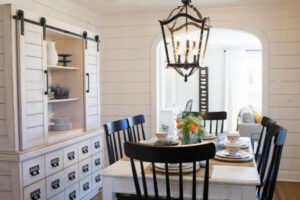
The Trademark: The “nickel gap,” a tiny, dark shadow line between boards, is the trademark of Shiplap. It has a laid-back, coastal, or farmhouse-chic vibe.
Doing It Yourself: Installing it is not too difficult. All you have to do is nail it directly into the wall through the front. The drawback? The nail heads will be visible. To add to the rustic, lived-in vibe, most people simply fill them with a little putty and paint over them.
What Is Tongue and Groove? (How It Works + Benefits)
Tongue and Groove is the tailored suit of the wood paneling world, while shiplap is the casual flannel shirt. It’s a bit more “engineered.”
- How it works: The board has a groove (a slot) on one side and a literal tongue (a ridge) on the other. Like pieces of a puzzle, they “click” together.
- The Signature Look: T&G is considerably tighter. If you want a wall that looks seamless and solid, this is ideal. Because the interlocking joints prevent the boards from sagging over time, it is also the gold standard for ceilings.
- The Hidden Perk: You are able to “blind-nail” T&G. After driving the nail through the tongue at an angle, you slide it over the groove of the following board. The outcome? A spotless surface with no nail holes.
Shiplap vs Tongue and Groove: Key Differences
Shiplap uses overlapping boards with visible gaps, while tongue and groove boards interlock for a tight, seamless fit.
| Feature | Shiplap | Tongue and Groove (T&G) |
|---|---|---|
| Board Design | Overlapping boards with rabbet edges | Interlocking boards with tongue (ridge) and groove (slot) |
| Appearance | Visible gaps (“nickel gap”) | Tight, seamless fit |
| Installation | Face-nailed | Blind-nailed |
| Nail Visibility | Visible | Hidden |
| Difficulty | Easier DIY | More precise install |
| Best Use | Accent walls | Walls & ceilings |
| Ceilings | Not ideal | Best option |
| Maintenance | More finishing work | Minimal |
| Style | Rustic / farmhouse | Clean / modern |
Which One Should You Choose for Your Home?
Before you pull the trigger, ask yourself these three questions:
- Do you want to see the gaps? Choose Shiplap if you adore the “slotted” appearance of individual planks. Go to T&G if you want a high-end, smooth surface.
- How much work do you want to do after it’s up? You will be filling and sanding nail holes on each and every board with Shiplap. With T&G, you are essentially finished once the wood is up.
- Is it going on the ceiling? Really, use T&G for ceilings to avoid the hassle. It’s far more secure.
Real Wood, Straight from the Source
At Northern Log Supply, we don’t just ship boxes of wood; we source it directly from the forest. We can provide a smooth, contemporary finish for a suburban flip or a “rough-sawn” texture for a cozy cabin feel.
We’ll give you a quick tip: Staining is the worst part of any wood project. It takes a very long time to dry, is messy, and smells. Before your boards leave our shop, we can pre-finish and pre-stain them. They are prepared to be nailed up when they arrive at your door.
Still Unsure About Which to Choose?
Choose shiplap if you want:
- A more affordable option
- Faster, easier installation
- Visible lines or a farmhouse-style look
Choose tongue and groove if you want:
- A tighter, more seamless appearance
- Hidden fasteners
- Better long-term stability
If you just want the basics, that’s it. If you need more advice, give us a call. From measuring your area to selecting the best wood species for your climate, our staff at Northern Log can assist you with everything. Let’s build something that lasts.
Frequently Asked Questions
▼ Is shiplap or tongue and groove better?
Tongue and groove is better for a seamless, high-end look and is the preferred choice for ceilings because of its secure interlocking design. Shiplap is better for decorative walls where you want a visible gap and a more rustic style.
▼ What is the main difference between shiplap and tongue and groove?
Shiplap boards overlap and create visible gaps between planks, while tongue and groove boards interlock tightly to form a smooth, seamless surface.
▼ Can you use shiplap on ceilings?
You can use shiplap on ceilings, but it’s not ideal because the boards can shift and create gaps over time. Tongue and groove is usually the better option for ceilings because of its tighter fit.
▼ Is tongue and groove more expensive than shiplap?
Tongue and groove is typically more expensive because of its precision milling and tighter installation system. It may save time later, though, since it often requires less finishing work after installation.
▼ Which is easier to install: shiplap or tongue and groove?
Shiplap is generally easier for DIY installation because it can be face-nailed directly to the wall. Tongue and groove takes a little more precision but gives you a cleaner finished look.
▼ Does shiplap always have gaps?
Traditional shiplap usually has a small visible gap between boards, often called a nickel gap. That spacing is part of the look that makes shiplap easy to recognize.